Why does ChatGPT name your agency but never link to it? We measured it on a real one.
Because the engines trust other sources more than your website. In a September 2026 review of an independent insurance agency, ChatGPT and Gemini named it in 37.5% of their answers, more than any competitor, and linked to its website in 1 of the 17 answers that searched the web. When ChatGPT wanted a source for a local agency, it linked a directory. For a smaller rival, it linked the rival's own site.
Each engine let the agency down for a different reason, and each reason has a different fix. Below: what each engine did, the one thing on the agency's own site that made it worse, and how to check yours in twenty minutes.
Three engines, three different reasons.
We asked each engine the same 12 questions a business owner would ask, in a real browser, and saved every answer.
| What it did | Why it did not link | The fix | |
|---|---|---|---|
| ChatGPT | Showed local agencies as a row of cards. The agency was in the row on most local questions. | It sourced the agency to Expertise.com and Birdeye every time. It sourced the rival to the rival's own website. | Be listed, complete and consistent on the directories ChatGPT reads for your town. Then give it a page of yours worth quoting. |
| Gemini | Named the agency first on three of the five questions that mentioned its city. | Its city answers are Google place cards, and place cards carry no links at all. Ask about the county or the region and the cards, and the agency, disappeared. | Treat the Google Business Profile as the asset that ranks there. Write pages for the wider area you actually serve. |
| Claude | Switched between place cards and open web search on the same question, run to run. | When it searched the open web it did link the agency twice, both times to a deep commercial page, never the homepage. | Make the homepage citable: one plain paragraph on who you are, what you insure and where. |
The website gave two different addresses.
Worked example: the most damaging finding
The footer, written for people, showed one street address. The structured data on the same page, written for machines, declared a different street number about twenty doors down, and dropped the "Inc." from the legal name. A carrier's agent locator page listed the right address with a different phone number.
That matters more than any single ranking. Every other fix, from question markup to directory work, depends on the engines agreeing which business they are reading about. Here the agency's own site was the loudest source of disagreement.
| Footer, for people | Street number A, with a suite number |
| Structured data, for machines | Street number B, no suite, no "Inc." |
| A carrier's agent locator | Right address, different phone number |
| Google Business Profile | Legal name with "Inc." |
The fix takes an afternoon: make every one of those say exactly the same thing, then list every profile Google already shows for the business in the site's structured data. This site declared three; Google showed at least eight.
The AI Overview went to a smaller agency's plain page.
Google showed an AI Overview on 2 of the 15 searches we tracked. The agency was cited in neither. On the workers compensation search for its own city, the Overview cited two local agencies smaller than this one, and the page it lifted was nothing special to look at: a definition first, five numbered coverage components, six client questions as headings, and markup saying what the business is and what it sells.
The agency already held the second map spot for that search. Its own workers compensation page for that city returned a 404. Format beat size, and the agency had left the door open.
Why this is worth fixing now.
People now ask an AI assistant to find an insurance agent almost as often as they ask Google. In the keyword data behind this review, "insurance agent" drew about 27,100 Google searches a month and an estimated 24,800 AI answers; "insurance broker" drew 33,100 and 23,200 (DataForSEO, US monthly estimates, September 2026). That is not future demand. It is already here, and this agency was earning almost none of the links from it.
Two things agencies get wrong about this.
"More reviews will fix it."
Not on their own. In this market the businesses holding the map spots for the commercial searches had 9, 10 and 12 reviews, against this agency's 150 or more. On the question "which agency has the best reviews," the engines went to review directories and placed the agency fourth (ChatGPT) and third (Gemini) of five. Reviews count where the engines read them.
"The AI must be blocked from my site."
Not here. The site sent the same full page to GPTBot, ClaudeBot, PerplexityBot, Google-Extended and OAI-SearchBot. Access was fine. Structure was the problem: twelve headings already asked client questions, none marked up as questions, and every inner page carried breadcrumb markup and nothing else.
Check your own agency in twenty minutes.
- Ask like a client. In a private window, signed out, ask ChatGPT and Gemini: the best independent insurance agent in your town, who writes the product you most want to sell in your county, and which agency near you has the best reviews. Note three things each time: were you named, was your site linked, and which site was linked instead.
- Widen the map. Ask the same questions about your county and your region. If you vanish, you have the Gemini problem above.
- Compare your addresses. Put your footer, your Google Business Profile, your carrier locator pages and your site's structured data side by side. To see the structured data, open the page source and search for streetAddress.
- Find your question headings. If your pages already ask client questions, run one through Google's Rich Results Test and see whether they are marked up as questions.
- Click your own product pages. Every product and town you want to be found for should have a page that loads.
- Write the questions down. Ask the exact same ones again in three months. The change is the only number that matters.
Watch this review walked live.
We walked this agency's review on screen in Episode 1 of The AI-Ready Agent, our free webinar series for independent insurance professionals, presented by InsuranceWebX. The named-but-not-linked finding starts at 18:33.
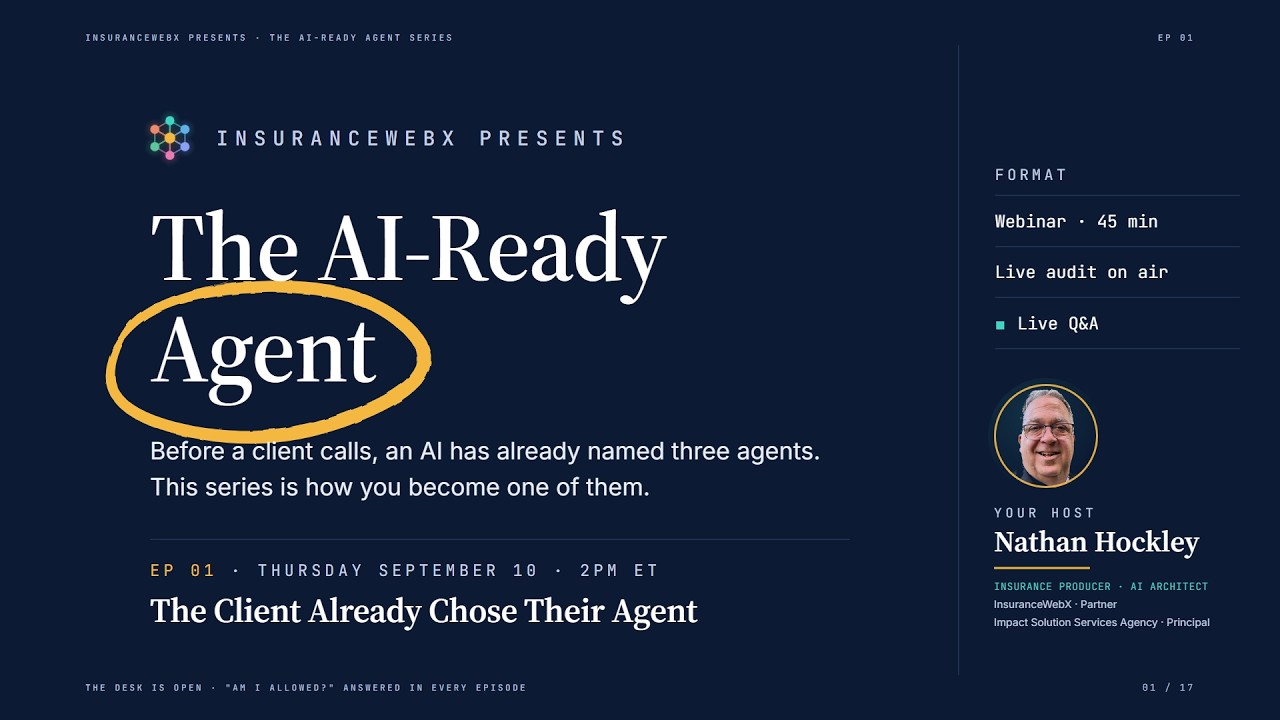
The AI-Ready Agent, Episode 1: The Client Already Chose Their Agent. Recorded September 10, 2026.
Episode 2, "Ranked Is Dead. Cited Is Everything.", goes further into citations. See the schedule and the other lessons.
Questions people ask
Why does ChatGPT link to Expertise.com or Birdeye instead of my website?
Because for a local business question it often answers from directory listings, and it cites the listing it read. In this review every ChatGPT card for the agency was sourced to a directory. Being complete and consistent on those directories is part of the job; a page of your own that answers the question directly is the other part.
What if AI never mentions my agency at all?
That is a different problem with a different fix. Another agency we reviewed was absent from all 15 target searches, all 81 map points we checked and every AI answer, and its own site files carried the wrong business name. Start with the foundations in our free fixes lesson.
Why do I get a different answer each time I ask?
The engines vary run to run, and some remember you. When we re-asked questions in this review, four verdicts moved. We kept Claude and Meta AI out of the headline because their answers showed account memory: Meta AI answered a question about a California agency as if the reader lived in our own Pennsylvania town. Ask signed out, and ask more than once.
Does an llms.txt file help?
Not by itself. This agency had one, and it was a flat list of about 60 KB of links. It did not make the site citable. Clear answers on the page, matching business details and the right markup did more.
How long before changes show up in AI answers?
There is no fixed timeline, which is why we freeze the questions and re-ask them word for word at three, six, nine and twelve months. The change between runs is what the review is for.

Founder of ElevAIte CRM and a licensed insurance producer in Pennsylvania and Maryland. He ran the review this article is built on.
Published · Updated
Keep reading
- Case studyFive AI Visibility Reviews side by sideThree businesses never named, two named but rarely linked.
- ServiceAI visibility auditFound, cited and answered, measured on your business.
- LessonHow clients choose an agent with AIThe short list of three, and why the first to answer wins it.
- IndustryCRM for insurance agentsThe leaks in a book of business, and what runs to close them.
Find out whether AI links to you. Then fix what it reads.
Start with a free market insight brief, or book a 30-minute working session to scope a full review.
Figures come from one AI Visibility Review run on September 10, 2026: 12 questions on ChatGPT and Gemini (24 pairs), most on a single pass; Claude and Meta AI were tested and reported separately. Search volumes are DataForSEO estimates. AI answers change over time. The agency's name and identifying details are withheld. Nothing here is a promise of rankings or citations.