How do clients choose an agent when they ask AI?
More and more clients start by asking ChatGPT, Gemini or Google's AI who to call, and the AI answers with a short list of about three names. The agents on that list are the ones the AI can find, read and verify through reviews, profiles, other sites that mention them, and pages that answer real client questions. Being on the list gets you considered; answering first usually decides who gets the conversation.
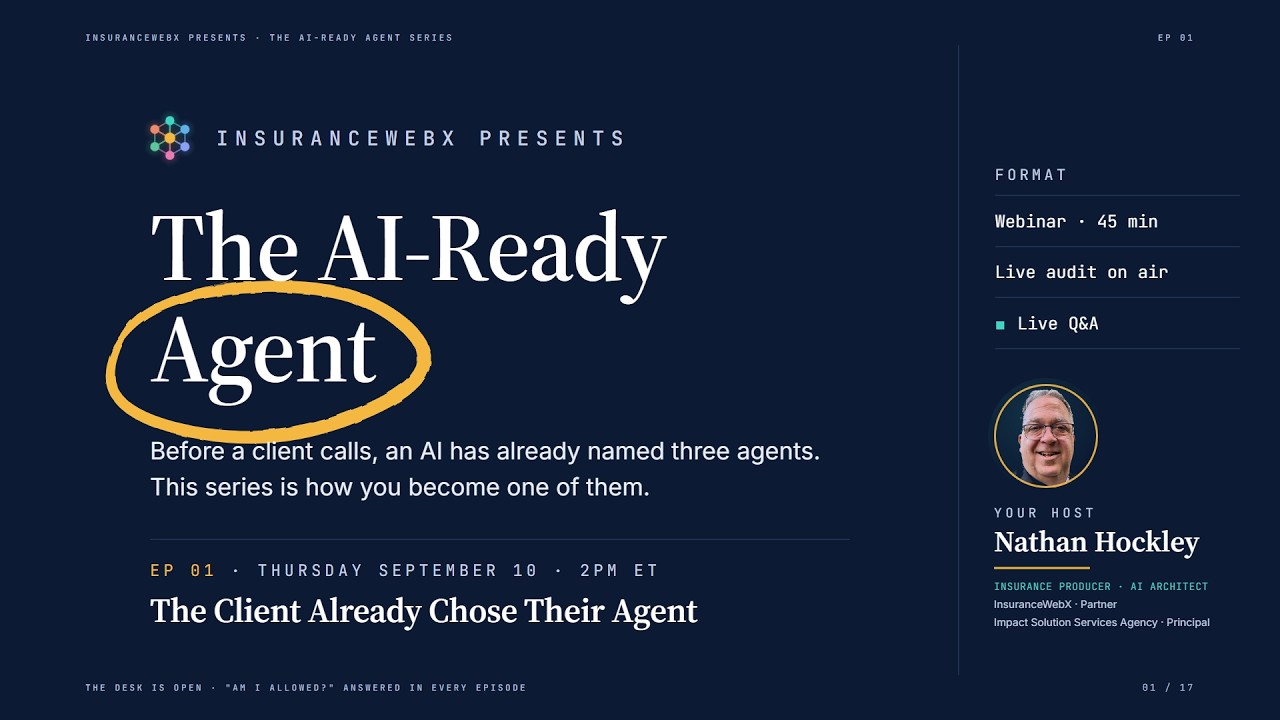
This page is the written version of Episode 1 of The AI-Ready Agent, a free webinar series for independent life, annuity and Medicare producers, presented by InsuranceWebX and hosted by Nathan Hockley. The episode walked through two real agency visibility audits on screen. The recording and its chapters are below.
of US Google searches ended without a click to any website between January and April 2026, up from 58.5% in 2024.
The client arrives already pre-sold
For twenty years the job was to rank, earn the click and then persuade. That sequence is breaking. When a searcher gets the answer on the results page or inside an AI tool, the persuading happens before anyone visits your site. Adobe found that 39% of US consumers already use AI to shop, and 72% of those treat it as their primary research tool (Adobe Analytics, 2025, 5,000 respondents).
Someone who picked you off an AI short list behaves less like a cold lead and more like a referral. They have already read about you, from sources they trust more than your own website. Buying research on business purchases points the same way: 6sense found that 95% of B2B buying groups bought from a vendor that was on their shortlist on day one (6sense Buyer Experience Report, 2025). That study measures business buyers, not households, but the shape is familiar to anyone who has taken a referral call.
What the AI looks at when it picks names
Authority used to come mostly from backlinks and rankings. In AI answers it comes from evidence the model can check across many sources. These are the signals the episode walked through, with the first fix for each.
| Signal | Why the AI trusts it | First fix |
|---|---|---|
| Recent reviews | Current reviews show the business is active and that real clients vouch for it. | Ask every client the same way, on the same schedule. Never ask only the happy ones. |
| Business profiles | Gemini leans on Google. ChatGPT leans on Bing. | Claim and complete the Google Business Profile, then import it into Bing Places. |
| Mentions on other sites | Directories, local press, associations and carrier listings confirm you exist outside your own site. | Keep your name, address and phone identical everywhere they appear. |
| Pages that answer questions | The AI splits one question into many smaller ones and looks for pages that answer each. | Write for questions clients ask, like how much life insurance do I need, not a list of products. |
| A site the bots can read | Some agent sites block AI crawlers by accident, and those sites never appear in answers. | Check robots.txt, confirm the site is indexed, and show address, service area, privacy and terms. |
| Speed of response | Not a ranking signal, but it decides which name on the list gets the business. | Online booking, instant text-back, and a Voice agent that answers when you cannot. |
Why the first to respond wins the list
Getting on the list is half the job. A client with three names will usually call or book with more than one, and the first useful response tends to win. The old speed-to-lead research still holds: first contact within five minutes converted about 8 times better than slower follow-up across more than 50 million sales interactions (InsideSales Lead Response Study, 2021).
Here is a hypothetical to make it concrete. A client in Adams County asks an AI tool for an independent life insurance agent near Gettysburg on a Tuesday evening, and gets three names. She calls all three. The first goes to a voicemail box that is full. The second calls back Wednesday afternoon. The third answers with a Voice agent that asks two qualifying questions and books a review for Thursday morning. All three were on the list. Only one has an appointment.
Two things people get wrong
Ranking on Google is not the same as being named by AI
A ranking is a list of links. An AI answer names a few businesses and cites what it trusted. The two audits in the episode found agencies that the AI mentioned by name while almost never citing their own websites as a source. The website was not doing the work; reviews and other sites were.
The AI can write all of it for you
Mass-produced articles with no real author do not build authority, and posting a few pages and then going quiet for months does not either. What earns citations is steady, specific content from someone who does the work, published under their name.
Watch the episode
The AI-Ready Agent, Episode 1: The Client Already Chose Their Agent. About an hour, recorded September 10, 2026.
Chapters
- Welcome, and what this series is
- How buyers pick an agent now
- Two registrant audits, run in advance
- The answer is the product
- Reviews, and why AI reads them
- Speed to lead
- The data: walking a live audit
- Named constantly, cited rarely
- Where the AI actually looks for sources
- Share of voice, and the competition
- Schema, and blocking the bots by accident
- What to fix on your site first
- Letting an AI answer the phone
- Google Business Profile and the P.O. box
- Next: the Agency Workshop
Questions from the room
Does ChatGPT use Google or Bing to find businesses?
Can I use a P.O. box on my Google Business Profile?
Is ranking on Google the same as being recommended by AI?
How long does it take to show up in AI answers?
Am I allowed to use AI to research my market?
Next in the library: the free fixes that decide whether AI can find your business, from the first Agency Workshop.
Answering first is the part we build
ElevAIte CRM, the AI and automation division of Impact Solution Services in Gettysburg, PA, installs the answering side of this for agents and small businesses: a Voice agent on the phone, instant text-back, booking and follow-up that does not go quiet. Start with a free market insight brief, or watch the next episode live.
Get your free market insight brief Register for Episode 2This page is education, not legal or compliance advice. Rules differ by state, carrier and product line; confirm with your compliance contact. For Medicare, CMS rules apply on top of everything here.