HomeLearnYour website and AI search
What does your website need to show up in AI answers? Twelve things, and one it cannot do alone.
A page an AI can read without running code, that says plainly who you are, what you do and where, answers the questions clients actually ask, and agrees with every other listing of your business down to the street number. In practice that is twelve checks: a descriptive title, a meta description, one main heading, enough words, questions and answers, business markup that matches your Google profile, reviews, credentials, one consistent name and address, a way to book, a page per service, and educational pages.
We score every site against that list in our AI Visibility Reviews, ten so far. The defects below are real, from those reviews. So is the catch: in two markets we reviewed, the business on top of the map won on its Google profile, not its website.
The twelve checks, and what we actually found.
Each item is scored from the page source, the way a crawler meets it. The right column is a real defect from one of our reviews.
| Why the engines care | What we found | |
|---|---|---|
| 1. A descriptive title | The title is the first line an engine reads about the page. It should say what and where. | A coach with links from 455 other websites had a title that was only his name. He was cited in none of 36 clean AI checks. |
| 2. A meta description | It is the summary engines and people see before they click. | The same site had none. An insurance agency's ran 191 characters and was cut off mid-word. |
| 3. One main heading | One H1 tells a machine what the page is about. | A training site had more than one H1 on 1,182 of its 1,185 pages. |
| 4. Enough words | A page needs substance to answer anything. We count 600 words as present. | Length is not the fix on its own: an agency whose service pages ran 3,600 to 6,100 words was linked in 1 of 17 AI answers. |
| 5. Questions and answers | AI engines split a client's question into smaller ones and look for pages that answer each. | That agency already had 12 question-form headings. None were marked up as questions. |
| 6. Business markup that matches | Structured data tells machines the business name, address and phone in a form they cannot misread. | One advisor's site code named a different business than her Google profile. Another agency's markup gave a different street number than its footer. |
| 7. Reviews on the site | Reviews are evidence the engines can check against the profile. | Three of the four competitors that scored 10 or 11 displayed reviews on their own pages. |
| 8. Credentials shown | A license number or designation is a fact a machine can verify. | Three of the four competitors scoring 9 or more showed a license or designation. |
| 9. One name and address | Engines cross-check every listing. Disagreement reads as doubt. | One business went by three names: one on its Google profile, one in its site code, one on a LinkedIn profile ranking for the owner's name. |
| 10. A way to book | A client who finds you at 9 PM books with whoever lets them. | An advisory firm's phone link dialed 555-555-5555, and its email link went to a retired domain. |
| 11. A page per service | An engine answering one question lifts one page. It needs a page for that service. | An agency held the second map spot for workers compensation in its city. Its page for that returned a 404. |
| 12. Educational pages | Pages that teach are the ones AI answers quote. | A trainer's signature page never defined the term it was named for, so there was no definition for an engine to quote. |
The same list, applied to this website.
Worked example: elevaitecrm.com
We rebuilt this site in September 2026 with the machine-readable half of the list in mind, and every detail is easy to check with a browser's View Source.
Every page ships its full text in the HTML, including the scroll demonstrations, so nothing waits for code to run. Every page carries markup naming the page, its author and the business, and all of it points to one company record and one person record, so the engines meet one ElevAIte and one Nathan Hockley. Questions and answers are marked up only where they appear on the page. Each article names its sources, and each case study says what was measured and what was not.
| llms.txt | Every page, with a one-line summary, grouped by section |
| Business markup | One organization and one person, referenced by every page |
| Question markup | Only on pages that show the questions |
| Rendering | Full text in the HTML, no JavaScript needed to read it |
| Lighthouse agentic browsing | 100 on all 30 pages, September 29, 2026 |
What we cannot show yet is the result. We have not yet measured how often AI answers cite this site, and we will publish the before and after when there is a change to report.
Two things the checklist cannot do.
Win the map by itself.
In a Medicare market we reviewed, the agent at the top of the map had a one-page site that scored 3 of 12, no better than the agency we were reviewing. In an advisor market, the firm holding the map on 6 of 12 searches ranked nowhere in the regular results. Both won on a complete Google profile and steady reviews. For local questions, Gemini answers from exactly that profile, so fix the profile first. Our free fixes lesson walks through it.
Fix anything with an llms.txt file alone.
An llms.txt file is a plain list that helps AI tools find your pages. One agency's was a 60 KB dump of every URL on the site. Another advisor's named the wrong business. A third firm had none. Written well, it helps a machine find your best pages. It does not make a weak page worth quoting.
Watch the schema and crawler checks explained.
Episode 1 of The AI-Ready Agent, our free webinar series for independent insurance professionals presented by InsuranceWebX, covers markup and accidental crawler blocking at 27:47, then what to fix on your site first.
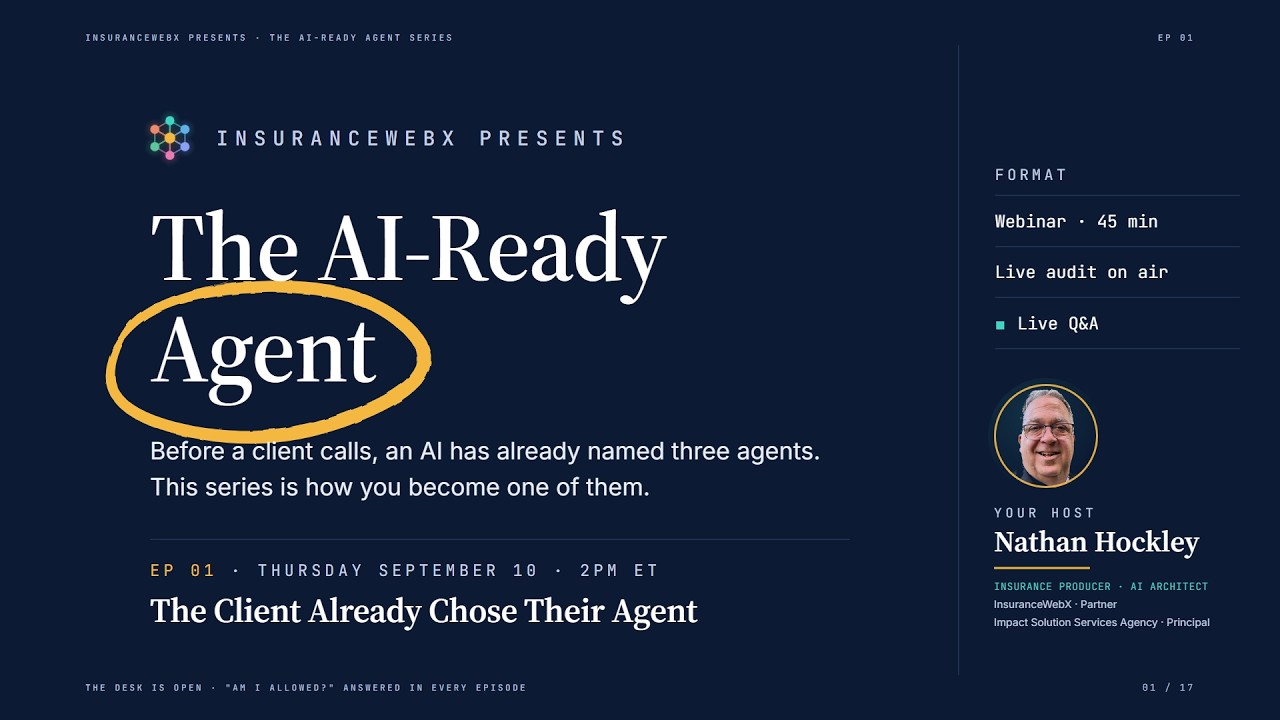
The AI-Ready Agent, Episode 1: The Client Already Chose Their Agent. Recorded September 10, 2026.
The hands-on version, fixing a volunteer advisor's site live, is the first Agency Workshop lesson.
Questions people ask
What is answer engine optimization?
Making a business easy for AI answer engines such as ChatGPT, Gemini, Claude and Google's AI Overviews to find, understand, trust and cite. It shares its foundations with SEO, but it is judged on whether the answer names you and links to you, not on where a link ranks.
Do I need an llms.txt file?
It is worth ten minutes, done correctly: your exact business name, what you do, where, and a list of your important pages with one line each. In our reviews, a wrong or bloated file was more common than a missing one, and no file on its own made a site citable.
Does schema markup help with AI search?
It helps machines agree on who you are, which every other fix depends on. It has to match what the page and your Google profile say. Markup that contradicts the footer, or claims an author or article that is not there, does harm; one restaurant we reviewed carried false article and author markup, and we removed it.
Can ChatGPT read my website?
Check two things. First, that your robots.txt does not block AI crawlers such as GPTBot, OAI-SearchBot, ClaudeBot and PerplexityBot. Second, that your page text is in the HTML and does not appear only after JavaScript runs; in one of our July reviews, a software company's pages showed their content only after scripts ran.
How is this different from the free fixes lesson?
That lesson covers the foundation outside your website: Google and Bing profiles, indexing, booking and one identity everywhere. This article covers the website itself, item by item.

Founder of ElevAIte CRM and a licensed insurance producer in Pennsylvania and Maryland. He runs the AI Visibility Reviews this article draws on and rebuilt this site with the same checks.
Published · Updated
Keep reading
- ArticleWhy AI names your agency but will not link to itThree engines, three different reasons, measured on one agency.
- LessonFree fixes to get found by AIThe profile and identity work outside your website.
- ServiceAI visibility auditFound, cited and answered, measured on your business.
- Case studyFive AI Visibility Reviews side by sideThree businesses never named, two named but rarely linked.
Want your site scored against the twelve?
Start with a free market insight brief, or book a working session to scope a full AI Visibility Review.
Findings come from AI Visibility Reviews run May to September 2026; engines, prompts and scope differed by review, and the businesses are not named. The checklist records presence, not quality. AI answers change over time. Nothing here is a promise of rankings or citations.